
Geothermal Heating & Cooling in Massachusetts
What geothermal actually involves in Massachusetts
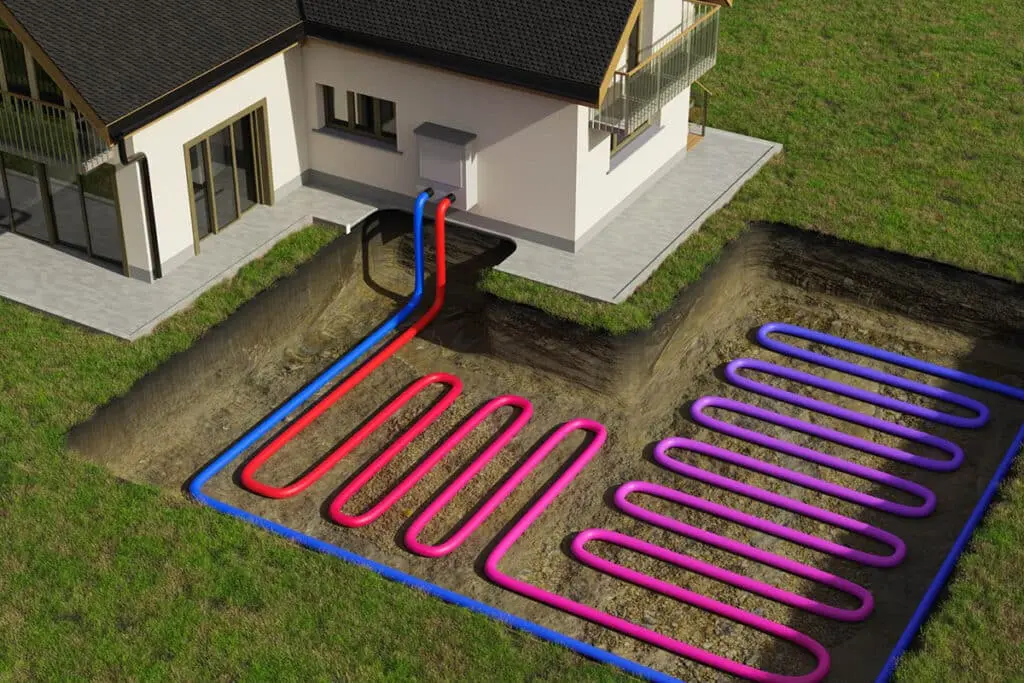
Geothermal — more precisely, ground-source heat pump systems — pulls heat from a closed water loop buried in the ground rather than from the outside air. In Massachusetts, geothermal installs typically run $30,000 to $60,000, with vertical-bore loop systems standard on smaller suburban lots and horizontal loops where land allows. Mass Save offers geothermal incentives that vary by sponsor; the federal Section 25D 30% credit expired December 31, 2025, which has materially changed the payback math.
Typical cost ranges in Massachusetts (2026)
- Central air conditioning: $5,000–$12,000 installed, depending on home size and ductwork condition. Does not qualify for Mass Save heat pump rebates.
- Single-zone ductless mini-split: $4,000–$9,000 installed. Qualifies for the Mass Save partial-home rebate ($1,125/ton).
- Whole-home ductless heat pump (3–5 zones): $12,000–$25,000 installed. Qualifies for the whole-home rebate of up to $8,500.
- Central ducted heat pump (existing ductwork): $10,000–$20,000 installed. Qualifies whole-home when sized via Manual J.
- Geothermal (ground-source) heat pump: $30,000–$60,000 depending on loop type.
Cost-after-rebate is what actually hits your bank account. A $20,000 whole-home heat pump install in 2026 nets to roughly $11,500 after the $8,500 Mass Save rebate, and the HEAT Loan can finance the remainder at 0% APR for up to 7 years. Run your own scenario in the rebate calculator.
Massachusetts incentives
Geothermal & Mass Save: what qualifies in 2026
See the full Mass Save rebates hubVerified 2026-09-19
Whole-Home Heat Pump Rebate
$2,650 /ton
Capped at $8,500 per home
The installed heat pump must be the sole source of heating and cooling for the spaces served. Equipment must be ENERGY STAR Cold Climate certified and listed on the Mass Save Heat Pump Qualified Products List (HPQPL). A Manual J load calculation is needed to qualify for the sizing bonus and is industry-standard practice on Mass Save projects.
Partial-Home / Supplemental Heat Pump Rebate
$1,125 /ton
Capped at $8,500 per home
Heat pump installed alongside an existing primary heating system. Equipment must be on the HPQPL. Lower per-ton rebate reflects supplemental rather than sole-source use.
Basic Heat Pump Rebate
$250 /ton
Capped at $2,500 per home
New for 2026. Applies to replacing an existing heat pump with a new qualified HPQPL-listed heat pump, or conditioning a previously unconditioned space.
$500 Right-Sized Equipment Bonus Partial-home
Partial-home installs only. Equipment must be sized to meet 90–120% of the total heating load at the outdoor design temperature, documented via an ACCA Manual J load calculation submitted with the rebate application.
$500 Weatherization Bonus Partial-home
Partial-home installs only. Requires a Mass Save Home Energy Assessment plus installation of the recommended weatherization (typically air sealing and insulation) within one year prior to or up to six months after the heat pump installation.
Financing
Mass Save HEAT Loan
0% APR up to $25,000
- Below 135% of State Median Income: 7 years (84 months)
- 135%–300% of State Median Income: 5 years (60 months)
- Over 300% of State Median Income: 3 years (36 months)
Subject to bank underwriting through participating Massachusetts lenders. Covers equipment + installation costs for qualifying high-efficiency upgrades (heat pumps, ductless mini-splits, insulation, water heaters, and batteries enrolled in ConnectedSolutions). A Home Energy Assessment is mandatory before financing a whole-home heat pump. Households below approximately 81% SMI typically route to Mass Save's no-cost / enhanced-rebate programs rather than the HEAT Loan.
No federal heat pump tax credit applies in 2026.
- Section 25C Energy Efficient Home Improvement Credit (heat pump portion) (30% of cost up to $2,000 annually for qualifying heat pump installations (inflation reduction act expansion)) ended for property placed in service after 2025-12-31 under the One Big Beautiful Bill Act (P.L. 119-21).
- Section 25D Residential Clean Energy Credit (geothermal portion) (30% of installed cost for ground-source (geothermal) heat pumps, with no dollar cap) ended for property placed in service after 2025-12-31 under the One Big Beautiful Bill Act (P.L. 119-21).
Status as of 2026-09-19: neither 25C nor 25D has been reinstated or replaced by Congress. Pending bills (e.g. H.R. 616) have not advanced. Pre-2026 §25D installs may carry forward unused credits.
Rebate amounts and eligibility verified 2026-09-19 against primary program documentation. We re-check before any publish.
Get a quote using these ratesWho qualifies for the Mass Save rebate
Mass Save heat pump rebates are available to residential electric or gas customers of the six program sponsors. Look up your specific city's electric and gas sponsor in the Mass Save sponsors directory. Customers of Municipal Light Plants (towns like Belmont, Braintree, and Reading) do not participate in Mass Save — they have access to the MLP Zero-Interest Energy Efficiency Loan instead. Income-qualified households may stack significantly higher incentive packages, including the IRA HEAR rebate (up to $8,000) on top of the standard Mass Save tier. Full eligibility detail lives in the Mass Save eligibility guide.
How the install process works
- In-home assessment. A Mass Save HPIN installer measures rooms, examines ductwork and the electrical panel, and runs a Manual J load calculation. This step is non-negotiable for rebate eligibility.
- Equipment selection. The installer proposes specific make/model heat pump or AC equipment from the Mass Save HPQPL (for heat pumps) or matched to your home (for standard AC).
- Quote & rebate paperwork. You receive a written quote with the rebate amount itemized. Sign-off triggers permitting through the local building department.
- Installation. Most projects complete in 1–3 days; multi-zone ductless can run 3–5 days. Geothermal loop drilling adds a separate phase.
- Rebate processing. Your HPIN installer files the rebate on your behalf — funds typically arrive in 6–10 weeks.
Explore geothermal in detail
- Geothermal Heating and Cooling System in MassachusettsA geothermal heating and cooling system in Massachusetts is a ground-source heat pump paired with a closed-loop water circuit buried in your property — typ
- Geothermal Heating System in MassachusettsA geothermal heating system in Massachusetts pulls heat from a constant 45–55°F ground-loop water circuit rather than from outdoor air, delivering year-rou
- Geothermal Heat Pump Installation in MassachusettsGeothermal (ground-source) heat pump installation in Massachusetts costs $30,000 to $60,000 depending on loop type and home size. Mass Save geothermal ince
- Geothermal Cost in Massachusetts (2026)A typical Massachusetts residential geothermal install runs $30,000 to $60,000, with horizontal loops at the low end and vertical-bore systems at the high
- Geothermal Ground Loop Types for Massachusetts HomesMassachusetts geothermal installs use one of four loop types: horizontal (cheapest, needs land), vertical-bore (most common in dense MA neighborhoods), pon
Geothermal by Massachusetts city
- Boston Suffolk County · Eversource
- Worcester Worcester County · National Grid
- Springfield Hampden County · Eversource
- Cambridge Middlesex County · Eversource
- Lowell Middlesex County · National Grid
- Brockton Plymouth County · National Grid
- Quincy Norfolk County · National Grid
- Lynn Essex County · National Grid
- New Bedford Bristol County · Eversource
- Fall River Bristol County · National Grid
- Newton Middlesex County · Eversource
- Somerville Middlesex County · Eversource
Frequently Asked Questions
- How much does geothermal cost in Massachusetts?
- Geothermal (ground-source heat pump) installation in Massachusetts typically costs $30,000–$60,000 depending on loop type and home size. Horizontal loops are cheapest but need open land; vertical-bore loops are standard in dense MA neighborhoods.
- Is the 30% federal geothermal tax credit still available?
- No. The federal Section 25D Residential Clean Energy Credit — the 30% geothermal credit — expired December 31, 2025 under the One Big Beautiful Bill Act. Property placed in service after that date does not qualify.
- How long does a geothermal system last?
- The indoor heat pump unit typically lasts 20–25 years; the ground loop itself can last 50+ years. That longevity helps offset the higher upfront cost, especially when paired with current Mass Save geothermal incentives.
- Do I need a lot of land for geothermal?
- Not necessarily. Horizontal loops need significant open land (roughly a third to half an acre), but vertical-bore loops only need enough yard for a drilling rig and a few small wellheads — workable on most Massachusetts suburban lots.
See your real cost after Mass Save rebates.
Connect with a vetted Massachusetts HPIN installer in minutes — no obligation.