
Geothermal in Boston, MA
What's specific to Boston
Boston's South End and Back Bay are dominated by 1850s–1870s Victorian brick and brownstone rowhouses built four to five stories on filled tidelands, with party walls and no rear yards that materially constrain outdoor condenser placement. Triple-deckers are common in Dorchester, Roxbury, and Hyde Park; West Roxbury and parts of Roslindale lean post-war single-family. Most homes do not have original central ductwork, which is why ductless mini-split heat pumps are the dominant retrofit path here.
Boston climate & sizing
Boston Logan's ASHRAE 2009 99% heating design dry-bulb temperature is 12.4°F — milder than inland Worcester thanks to coastal moderation, but humid enough that summer dehumidification capacity (not raw BTUs) often drives equipment sizing. Cold-climate certification is still required for whole-home Mass Save qualification.
99% winter design temperature: 12.4°F (Boston Logan Int'l (ASHRAE 2009)). Heat-pump capacity at this temperature is the number to validate when reviewing a Manual J load calculation.
Mass Save sponsor & utility
Mass Save in Boston is administered through Eversource (electric) and National Grid (gas). That sponsor processes your heat pump rebate (up to $8,500 standard in 2026, up to $16,000 enhanced for income-qualified households) and the HEAT Loan referral. See the full sponsor directory if you'd like to verify your account.
Note: Boston Gas Company d/b/a National Grid.
Permits & historic review in Boston
Residential HVAC permits in Boston are issued by the Inspectional Services Department (ISD), Building Division. Gas work typically requires a separately-pulled gas permit; your licensed installer files both.
The Back Bay Architectural Commission and Beacon Hill Architectural Commission both require approval for HVAC condensers and mini-split heads visible from any public way; rooftop placement set well back from cornices is the typical approved location for those neighborhoods.
Realistic cost-after-rebate for a Boston home
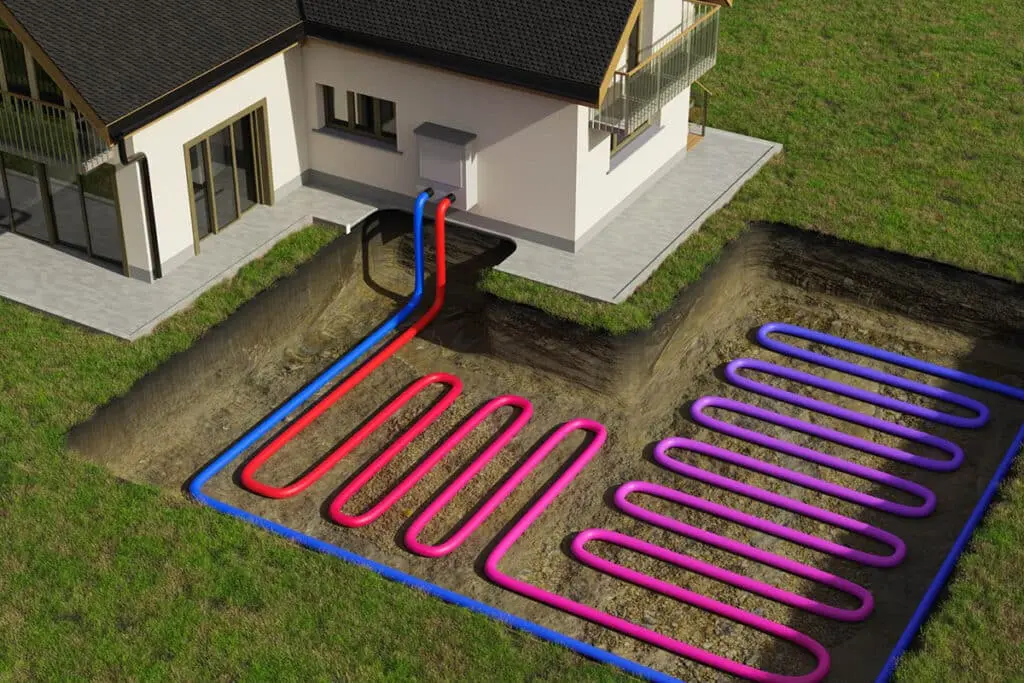
Geothermal (ground-source) heat pump installation in Boston typically runs $30,000–$60,000 depending on loop type and home size — horizontal closed loops are cheapest when sufficient yard is available; vertical-bore loops are standard in dense Massachusetts neighborhoods and add $10,000–$25,000 in drilling cost. Mass Save offers a dedicated geothermal whole-home rebate of up to $13,500 in 2026 (separate from and higher than the $8,500 air-source cap), and income-qualified households may stack up to $25,000 in enhanced geothermal incentives. The federal Section 25D 30% credit expired December 31, 2025 under the One Big Beautiful Bill Act, so payback math now relies on state and utility incentives plus the long operating-cost advantage. The 0% HEAT Loan up to $25,000 still applies.
Run your own numbers in the Mass Save rebate calculator using your expected system tonnage. Income-qualified households at or below 80% AMI may also stack an additional HEAR rebate up to $8,000 on top of the Mass Save rebate.
Verified 2026-09-19
Whole-Home Heat Pump Rebate
$2,650 /ton
Capped at $8,500 per home
The installed heat pump must be the sole source of heating and cooling for the spaces served. Equipment must be ENERGY STAR Cold Climate certified and listed on the Mass Save Heat Pump Qualified Products List (HPQPL). A Manual J load calculation is needed to qualify for the sizing bonus and is industry-standard practice on Mass Save projects.
Partial-Home / Supplemental Heat Pump Rebate
$1,125 /ton
Capped at $8,500 per home
Heat pump installed alongside an existing primary heating system. Equipment must be on the HPQPL. Lower per-ton rebate reflects supplemental rather than sole-source use.
Basic Heat Pump Rebate
$250 /ton
Capped at $2,500 per home
New for 2026. Applies to replacing an existing heat pump with a new qualified HPQPL-listed heat pump, or conditioning a previously unconditioned space.
$500 Right-Sized Equipment Bonus Partial-home
Partial-home installs only. Equipment must be sized to meet 90–120% of the total heating load at the outdoor design temperature, documented via an ACCA Manual J load calculation submitted with the rebate application.
$500 Weatherization Bonus Partial-home
Partial-home installs only. Requires a Mass Save Home Energy Assessment plus installation of the recommended weatherization (typically air sealing and insulation) within one year prior to or up to six months after the heat pump installation.
Financing
Mass Save HEAT Loan
0% APR up to $25,000
- Below 135% of State Median Income: 7 years (84 months)
- 135%–300% of State Median Income: 5 years (60 months)
- Over 300% of State Median Income: 3 years (36 months)
Subject to bank underwriting through participating Massachusetts lenders. Covers equipment + installation costs for qualifying high-efficiency upgrades (heat pumps, ductless mini-splits, insulation, water heaters, and batteries enrolled in ConnectedSolutions). A Home Energy Assessment is mandatory before financing a whole-home heat pump. Households below approximately 81% SMI typically route to Mass Save's no-cost / enhanced-rebate programs rather than the HEAT Loan.
No federal heat pump tax credit applies in 2026.
- Section 25C Energy Efficient Home Improvement Credit (heat pump portion) (30% of cost up to $2,000 annually for qualifying heat pump installations (inflation reduction act expansion)) ended for property placed in service after 2025-12-31 under the One Big Beautiful Bill Act (P.L. 119-21).
- Section 25D Residential Clean Energy Credit (geothermal portion) (30% of installed cost for ground-source (geothermal) heat pumps, with no dollar cap) ended for property placed in service after 2025-12-31 under the One Big Beautiful Bill Act (P.L. 119-21).
Status as of 2026-09-19: neither 25C nor 25D has been reinstated or replaced by Congress. Pending bills (e.g. H.R. 616) have not advanced. Pre-2026 §25D installs may carry forward unused credits.
Rebate amounts and eligibility verified 2026-09-19 against primary program documentation. We re-check before any publish.
Get a quote using these ratesEquipment & qualification for Boston
Geothermal's payback profile is materially different than it was through 2025. The federal 30% credit is gone, but ground-source heat pumps still operate at coefficients of performance (COP) of 4–5 versus ~3 for air-source units — an efficiency edge that compounds annually over the 20+ year ground-loop life. The decision math favors geothermal in Boston homes where (1) loop installation is feasible (yard space or a drillable site), (2) the homeowner plans to stay 10+ years, and (3) existing heating fuel is oil or propane rather than gas.
Vetting a Boston HVAC installer
- Massachusetts Refrigeration Technician (RT) license (verify with the state Board of Examiners).
- Mass Save Heat Pump Installer Network (HPIN) enrollment — required for rebate filing. (See the vetting guide for what to ask.)
- Liability insurance and workers' compensation.
- Provides ACCA Manual J load calculation with the quote — required for whole-home Mass Save rebate eligibility (90–120% of design heating load), and required to qualify for the $500 sizing bonus on partial-home installs.
- Quote itemizes equipment, install labor, permitting through Inspectional Services Department (ISD), Building Division, and the rebate amount.
- IGSHPA-accredited (existing AI credential holders) or CSA-certified (new installers post-Jan 2026) loop designer on the project team.
- Drilling subcontractor holds a current MassDEP Well Driller Certification (310 CMR 46.00) for any vertical-bore loop.
- Quote separates equipment, indoor install labor, and loop installation/drilling — three distinct line items.
- Loop length, depth, and grout spec documented in writing, with a 50-year warranty on the loop itself.
More on Geothermal in Massachusetts
Geothermal in nearby MA cities
- Geothermal in Cambridge, MAGeothermal heat pump installation in Cambridge typically runs $30,000–$60,000 depending on loop type; Mass Save geothermal incentives apply, though the fed
- Geothermal in Somerville, MAGeothermal heat pump installation in Somerville typically runs $30,000–$60,000 depending on loop type; Mass Save geothermal incentives apply, though the fe
- Geothermal in Newton, MAGeothermal heat pump installation in Newton typically runs $30,000–$60,000 depending on loop type; Mass Save geothermal incentives apply, though the federa
- Geothermal in Quincy, MAGeothermal heat pump installation in Quincy typically runs $30,000–$60,000 depending on loop type; Mass Save geothermal incentives apply, though the federa
Other HVAC services in Boston
- Air Conditioner Installation in Boston, MAAir conditioner installation in Boston comes down to choosing among three systems — central AC, ductless mini-splits, and heat pumps — at $5,000–$18,000 in
- Ductless Mini-Splits in Boston, MADuctless mini-split installation in Boston runs $4,000–$9,000 per zone; whole-home cold-climate systems qualify for Mass Save rebates of up to $8,500 in 20
See all HVAC services available in Boston in one place.
Frequently Asked Questions
- How much does geothermal heating and cooling cost in Boston?
- Geothermal in Boston typically falls in the same Massachusetts ranges as on the pillar page — local cost-drivers in Boston include boston's south end and back bay are dominated by 1850s–1870s victorian brick and brownstone rowhouses built four to five stories on filled tidelands, with party walls and no rear yards that materially constrain outdoor condenser placement.
- Which Mass Save sponsor serves Boston?
- Mass Save in Boston is administered through Eversource (electric) and National Grid (gas). That sponsor processes your heat pump rebate (up to $8,500 standard or up to $16,000 enhanced for income-qualified households in 2026) and the HEAT Loan referral.
- Who issues HVAC permits in Boston?
- Residential HVAC permits in Boston are issued by the Inspectional Services Department (ISD), Building Division. Your licensed installer typically files the mechanical and gas permits on your behalf.
- Does Boston have historic-district review for HVAC?
- The Back Bay Architectural Commission and Beacon Hill Architectural Commission both require approval for HVAC condensers and mini-split heads visible from any public way; rooftop placement set well back from cornices is the typical approved location for those neighborhoods.
- What heat pump equipment works best for Boston winters?
- Boston's 99% winter design temperature is 12.4°F per Boston Logan Int'l (ASHRAE 2009). For Mass Save whole-home qualification, choose only HPQPL-listed cold-climate models that maintain rated capacity at and below this design temperature, sized via ACCA Manual J.
See your real cost after Mass Save rebates.
Connect with a vetted Massachusetts HPIN installer in minutes — no obligation.